Friday, June 12, 2015

Book Review- “How to be a Happy Muslim- Insha’Allah”


When reading this book I couldn’t help but approach it from two different perspectives. Firstly, as a counsellor myself I automatically tended to read the book from the perspective of a counsellor. From this viewpoint I can sum this book up as an extremely valuable resource. It is definitely a book that I wouldn’t hesitate to recommend to all my clients. Throughout the book I felt almost as if the author was echoing my own thoughts and speaking my own mind.


What I found the most useful was that the book was written in such a simple and practical manner, there is no room for confusion or misunderstanding. The advice's are so clear and to the point that anyone can read it and implement the skills and lessons brought about, and further useful links to websites, videos and other resources are provided so that the experience of implementing change doesn't have to end with this book. Which brings me to the thing I loved the most about this book. The author takes an active stance instead of a passive/victim one and she encourages everyone to take control of their own lives and their own feelings. Instead of waiting for someone else to do something, she shows people how they need to do something themselves to become happy and she gives them the basic tools with which to do this. If anything, the thing that should be taken away from this book is that happiness (in terms of contentment and inner peace) is not something which only a few people can achieve, it is something attainable for everyone, but it involves some sort of action to be taken in order to maintain it.

In addition, the approach the book takes is holistic and it focuses on all aspects of human functioning and combines the different levels of functioning to show that happiness is a holistic thing in itself. In doing this, it highlights the need for us to view our lives holistically and from there to make the necessary changes on a more meaningful level.

My second approach to reading this book was from a personal level, with the constant awareness that this book applies to me as much as it does to any other person. On this level too, I was not disappointed. With every topic I found myself easily able to apply this to my own life. The thing that stood out for me personally was the discussion on gratitude and focusing on the positive in our lives over the negative. I can vouch that becoming more grateful leads to feelings of contentment and peace and the tools provided in the book to become more grateful and positive was very helpful in emphasizing this. I also found the Happiness Reflections and Happiness Hints to be very beneficial in bringing the topics back to my own life, thereby making the reading of this book a personal experience of reflection and self-understanding.


People often ask me the question, “but how can I become happy?” While reading this book I felt like I was getting a very in-depth answer to that question and I think that the next time I get asked this question, my answer should simply be to recommend them to read How to be a Happy Muslim-Insha’Allah. It is indeed a book which provides solutions to issues that many people are attempting to deal with and I am certain that many others will find it as helpful as I have, Insha’Allah. 

Image from here

You can read more on the author's website here 

Wednesday, April 8, 2015

Why I think fashion is oppressive


I might as well admit from the onset that my relationship with fashion has been a rocky one. It started out when I wanted to know fashion and I tried hard to embrace it and follow it, perhaps even understand it, but a long time ago this relationship ended, it just wasn’t sustainable, and it left me saddened and perhaps even on the verge of depression many times because I couldn’t live up to its standards. Then I came to the important realization, I am better off without fashion, because indeed fashion is oppressive and stifling! Let me tell you what makes me say this.


You see, I believe that while the clothes we wear can never define us, when we naturally choose what we want to wear, based on our likes and dislikes, then what we wear reflects our personality. When there are no restrictions, people tend to choose clothes that they really like, and this usually tells a lot about each unique individual’s personality. Someone may choose to wear long flowy dresses or skirts because that makes them feel good, or someone else may choose to wear tailored pants because they feel the most comfortable in it. In the same way, one woman may love wearing heels while another will never feel comfortable unless her shoes are flats. This diversity in choice allows us to choose according to our preferences and these preferences say a lot about our personalities.

So where does fashion fit in?

Well, fashion comes along and begins to tell us exactly what we should be wearing. It dictates to us that skinny jeans looks much better than baggy jeans, it tells us that the clothes we like are “so last season”. It chooses the type of shoes we should be wearing. It tells us what colours to wear, what accessories to match it up with, it even tells us what shops to buy our clothes at. And if we think we are special we will soon see that we are wrong, because fashion doesn’t consider our individual preferences or even what we feel comfortable in, fashion doesn’t care if we prefer skirts to pants, or whether we love flowing clothes instead of tailored clothes, no, fashion goes around dictating the same thing to every single woman, based on what fashion thinks is “in”,  until eventually we all begin to look the way fashion wants us to and fashions dreams of the perfect attire are realized.

Sounds a bit crazy doesn’t it? Yet that’s exactly what happens, and the odd thing is if someone really came about and told us exactly what to wear we would probably kick them out of our houses.

Now, before you think this doesn’t apply to Muslim women who have decided to wear abaya’s or cloaks or jilbaab (depending on what you refer to the clothes as). Let me tell you it applies just as much. If you think that Muslim women’s clothes are just pieces of black material sewn together to cover them then you are so wrong. Let me tell you, there are “in fashion” abayas and “out of fashion” ones, and there is such a thing as that headscarf that is “so last season”. Oh, and let me not forget the designer name brand cloaks, abayas, and hijabs, yes people, fashion hasn’t ignored Muslim women, and its role as the oppressor is exactly the same for Muslim women as it is for any other woman.

But wait, there’s more…


The most oppressive thing about fashion is how it makes us women feel. See, fashion uses perfect women as its models, and it forgets to tell us that only a very small percentage of us will ever look like these perfect women. So we strive and yearn to look like fashion’s models and when the things they model to us don’t exactly look right on us we don’t criticize fashion’s tastes, instead we blame ourselves. We use all kinds of labels against ourselves as we strive to follow what fashion wants us to, and we don’t stop to think that maybe we are fine the way we are and the problem actually lies with fashion!


So, my advice to all ladies would be, get out while you can!


It doesn’t matter if your style is “out of fashion” or “last season”, if it’s what you are comfortable in then that should be good enough. So what if you have been wearing the same shoes for the past two years. Who cares if no one else still wears the type of headscarf you are wearing? What’s the problem if the dress you are wearing looks like it belongs in the 1980s. Make your choices yourself, don’t allow fashion to dictate to you. I don’t know about you, but if I attempted to wear skinny jeans I would probably drop dead within minutes due to lack of being able to breathe properly! 


Image from here 

Thursday, March 12, 2015

The Best of All Creations


One of the most beautiful things to witness is true and positive human change. Alhamdulillah (Praise be to Allah) yesterday I had the opportunity to witness this again and it has left me humbled and in awe of how amazing Allah has created human beings. Indeed, it is the truth that humans are the Best of All Creations.


As I sat and listened to a group of Muslim Sisters share their experiences of growth and change I was reminded of the vast human potential that Allah has given us. It reminded me that we do not have to allow circumstances to shape us and neither do we need to remain stuck in a state of negativity. We have the ability to change and grow and become human beings who can contribute to others lives in a meaningful way.


It also allowed me to contemplate on what true empowerment really is and I’ve come to the conclusion that empowerment is not about getting what you want despite everyone else. It’s not about comparing yourself with anyone else and then deciding that you need to be equal. True empowerment according to my understanding is being so happy and content with yourself that you do not need to compare yourself with anyone, nor do you need to demand any rights. A truly empowered person understands that she is not more important than anyone else, that if she puts others before herself and if she gives to others then she will gain more than they do. A truly empowered person is the person who has the ability to admit to her mistakes, to understand her weaknesses, to accept the circumstances that she cannot change and to remain positive even in the worst situations of negativity. This may sound impossible, but Alhamdullillah yesterday once again reaffirmed to me that this is in fact not impossible at all.


I thank Allah Almighty for giving me the chance to witness the beauty of human beings becoming better people, this gives me a feeling I cannot properly explain, but it mostly it makes me understand the magnificence of the Ultimate Creator. Allah Almighty has made us the best of creations, we need to make sure we live up to that! 

Tuesday, December 30, 2014

“Diary of a Guji Girl” and What I think we should be discussing

Like many people I have been an avid reader of the blog ‘Diary of a Guji Girl’. Initially I was interested in reading the blog because of the huge hype that surrounded it, eventually though I found this to be an educational experience for me in many ways. So a few weeks ago I was delighted to have finally received my copy of the book based on the blog, and I set aside an evening just for reading this.( I must say as a side note that holding the book in my hands was so much better than reading the blog). Nonetheless, the book has marked the end of this story and like all stories I find myself at odds, there is closure, which is always a good thing, but for me the lessons derived from this story is far more important and it surpasses all the hype, the popularity and everything else that has come with this.


I admire the author Qaanitah Hunter for boldly discussing issues that no one else dare speak about, and I love that she has made such good use of satire and humour, there’s this nagging part of me though, a part that tells me that perhaps people didn’t take the messages from the book exactly in the way it was intended, that the characters were “glorified” by readers in ways that should not have happened and that the reflection of our society as portrayed in the story has not been concerning enough for people. Perhaps it’s just me over analysing things again, I don’t know, but in any case, I decided to mention the lessons that I have learnt and what I think we should be discussing after reading this story.

For those of you who aren’t familiar with the story, the very basic summary is that this is a story of a first year university student, Amina, who leaves her home in the small town of Newcastle to come to the big and sometimes very unfriendly city of Johannesburg. On the way she meets new people, has different experiences, but it is mainly Amina’s obsessive quest for marriage that forms the basis of this story, and it is her “relationship” with the typical messed up, unstable, but very good looking, rich and popular guy that forms the central focus.

The biggest lesson that I derived from this blog/book is also the scariest one so I’ll begin with that. While reading this it dawned on me that the biggest threat to the religion of Islam in South Africa is cultural heritage. Now, before people jump down my throat, please allow me to explain. Diary of a Guji Girl has very perfectly depicted how Muslims in South African Indian society hold on strongly to their cultural heritage. This in its own is not an issue, but it becomes an issue when it is at the expense of the way in which Islam is practised. The problem of cultural heritage surpassing Islamic teachings is so evident in the story, for instance when Amina judges her Cousin Ayesha’s future husband because he is not from the same cultural background. Besides this very overt depiction of what I am talking about, the characters in the story all tend to hold on to cultural practices like it’s the law. There is no questioning the relevance of these practices and very often cultural practices surpass religious ones and people are judged when they decide to choose religious practices over cultural ones.
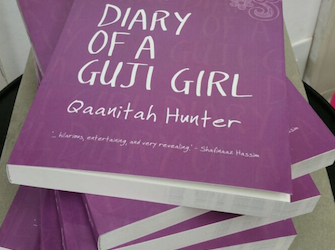

The reason for this being scary or worrying is that when people place more importance on their cultural heritage than anything else, this can cause division, racism and prejudice and it can be a huge hindrance to Islamic unity. I see this too often in the society in which we live, and coming from a mixed cultural background, I myself have been a recipient of the prejudice I allude to, and so reading about it in Diary of a Guji Girl just brought home this issue so aptly. But the scariest part of it all is that people don’t stop to think about the negative impact this may have and instead remain insistent that their particular culture is “the way things should be”. I personally think that Diary of a Guji Girl was an attempt to change this type of thinking, showing in a very satirical manner that maybe the way we have been thinking all the years is not always the right way. Whether readers actually took this message seriously however is another story.

The other issue that stood out for me was the overly obsessive pursuance of marriage. Now, I am not at all disputing the importance of marriage. Islam definitely does place emphasis on marriage and even regards it as “half of faith”. However, in this overly obsessive quest for marriage, we seem to have forgotten the true purpose of marriage in itself. Marriage is supposed to be a means to the end, not an end in itself. This Hollywood style search for happily ever after, (or in this case, the happily ever after in the smart Houghton house with the good looking, rich and popular man) can only lead to trouble. As Muslims the only happily ever after that we are supposed to be pursuing is the one we are promised in the Hereafter. If marriage is not going to make us better Muslims who are constantly trying to improve ourselves in our striving to reach closeness to Allah Almighty, then this means is not a very positive means to the ultimate end, now is it? With this crazy obsessive search for the perfect man and seemingly perfect life, it’s no wonder people get divorced so easily these days. May Allah guide and protect us all!

The last issue that I’ll mention here is the materialistic nature of people. As the protagonist in the story, Amina’s materialistic nature actually becomes so annoying that at some points you want to smack some sense into her. This is more evident in the blog posts than it is in the book, but nonetheless, it highlights the fact that many of us have lost the plot and we have become selfish and self-absorbed. I don’t know how other people feel, but for me spending R2000 rand on one shopping trip on nothing other than clothes is absurd. I love that the author made an attempt to bring Amina back to reality and make her realise that life is about responsibility and not being wasteful, and of course about sharing with others as well if you can afford to do so.

There is so much more that I can say about this story, so much more details to discuss about the issues brought about in it, that’s why I was disappointed when all people could focus on was the “love story”. Naturally this brought up a whole lot of other questions for me. Why do people love Moe and Amina together? What is it about the attraction of ‘good girls’ to the ‘bad boy’? Is life really all about finding love? What are our ideas of love even based on? Should young women really be putting themselves out there and doing whatever they can to secure a good marriage prospect? How much will parents overlook and give in so that their daughters end up marrying a good man? Is society’s viewpoint really that important? Has money and status really become so important to us that we are willing to compromise on our Islamic values? …


Yes, it is evident that there is much more that I can discuss about this story, but the story has ended so perhaps I should end my thoughts here as well. I would love to hear other thoughts on this though, perhaps someone else has good answers to all my many questions.

Image 1 from here 
Image 2 from here  
Image 3 from here


Thursday, November 20, 2014

Stupid old stereotypes and inspiring Muslim women


I’ve long since given up the need to refute common stereotypes about Muslim women. Of course I’ve always known that these stereotypes were nothing short of ridiculous. I’ve said this numerous times, and will say it again, Muslim women can never be stereotyped and categorized into one general whole. Nonetheless, I’ve recently come into contact with Muslim women involved in so many different projects that it reminded me that stereotypes are undoubtedly a sign of stupid thinking. So I thought I’d just share with you some of the projects that Muslim women in my community have recently begun.


My favourite project is the recent development of a Book club, cleverly named “Book Bytes”, this book club ensures that Muslim women (and women from other faiths who would like to join) come together and discuss their favourite reads and encourage each other to read new and different books. I have not previously been exposed to so many women who love reading to the extent that I do and I must say that I am impressed. This proved to me that intellectual thought and intelligence is vivid and thriving amongst Muslim women and contrary to a common stereotype, there are women out there who would prefer to buy books over shoes any day!


Last month some time I was invited to speak at a support group. This group called, H4U (Here for You) has been established by two very ambitious, bold and outgoing Muslim women who have the intention of improving the community in which they live. I left that meeting feeling so impressed and inspired by all that I had heard. It’s always a beautiful thing to witness or hear about the growth in someone else. It reminds me of the vast human potential that we have and how anyone is able to accomplish whatever they want to.


As part of this support group these women are involved in a variety of projects, including drug 
counselling and support, and counselling and assistance for many other issues. They’ve also set out to do youth upliftment and a kiddie’s recreational programme. Honestly I know how much time and effort it takes to arrange all these activities and projects and I really admire these women for their selflessness.


Then, just recently I was put in touch with a dynamic group of Muslim sisters, most of whom had converted to Islam fairly recently. I can’t tell you how impressive these women are. Masha Allah! The genuine love and care that they have for one another and the support that they constantly offer each other has left me in awe. I pray that their bonds are strengthened.


These are just a few of my most recent encounters with amazing Muslim women. I have had many others, and I am certain that there will be many more. For this reason, I now have resorted to smiling silently or simply dismissing the relentless stereotypes of Muslim women. If anyone is stupid enough to believe and follow these stereotypes, then all I can say is that there’s a major problem with them and there’s not much else I can do about that.