Like many people I have been an avid
reader of the blog ‘Diary of a Guji Girl’.
Initially I was interested in reading the blog because of the huge hype that
surrounded it, eventually though I found this to be an educational experience
for me in many ways. So a few weeks ago I was delighted to have finally
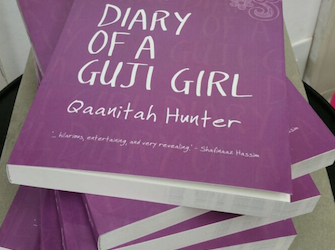
received my copy of the book based on the blog, and I set aside an evening just
for reading this.( I must say as a side note that holding the book in my hands
was so much better than reading the blog). Nonetheless, the book has marked the
end of this story and like all stories I find myself at odds, there is closure,
which is always a good thing, but for me the lessons derived from this story is
far more important and it surpasses all the hype, the popularity and everything
else that has come with this.

I admire the author Qaanitah
Hunter for boldly discussing issues that no one else dare speak about, and I
love that she has made such good use of satire and humour, there’s this nagging
part of me though, a part that tells me that perhaps people didn’t take the
messages from the book exactly in the way it was intended, that the characters
were “glorified” by readers in ways that should not have happened and that the reflection
of our society as portrayed in the story has not been concerning enough for
people. Perhaps it’s just me over analysing things again, I don’t know, but in
any case, I decided to mention the lessons that I have learnt and what I think
we should be discussing after reading this story.
For those of you who aren’t
familiar with the story, the very basic summary is that this is a story of a
first year university student, Amina, who leaves her home in the small town of
Newcastle to come to the big and sometimes very unfriendly city of
Johannesburg. On the way she meets new people, has different experiences, but
it is mainly Amina’s obsessive quest for marriage that forms the basis of this
story, and it is her “relationship” with the typical messed up, unstable, but
very good looking, rich and popular guy that forms the central focus.
The biggest lesson that I derived
from this blog/book is also the scariest one so I’ll begin with that. While
reading this it dawned on me that the biggest threat to the religion of Islam
in South Africa is cultural heritage. Now, before people jump down my throat,
please allow me to explain. Diary of a
Guji Girl has very perfectly depicted how Muslims in South African Indian society
hold on strongly to their cultural heritage. This in its own is not an issue,
but it becomes an issue when it is at the expense of the way in which Islam is
practised. The problem of cultural heritage surpassing Islamic teachings is so
evident in the story, for instance when Amina judges her Cousin Ayesha’s future
husband because he is not from the same cultural background. Besides this very
overt depiction of what I am talking about, the characters in the story all
tend to hold on to cultural practices like it’s the law. There is no
questioning the relevance of these practices and very often cultural practices
surpass religious ones and people are judged when they decide to choose
religious practices over cultural ones.
The reason for this being scary
or worrying is that when people place more importance on their cultural
heritage than anything else, this can cause division, racism and prejudice and
it can be a huge hindrance to Islamic unity. I see this too often in the society
in which we live, and coming from a mixed cultural background, I myself have
been a recipient of the prejudice I allude to, and so reading about it in Diary of a Guji Girl just brought home
this issue so aptly. But the scariest part of it all is that people don’t stop
to think about the negative impact this may have and instead remain insistent
that their particular culture is “the way things should be”. I personally think
that Diary of a Guji Girl was an attempt
to change this type of thinking, showing in a very satirical manner that maybe
the way we have been thinking all the years is not always the right way.
Whether readers actually took this message seriously however is another story.
The other issue that stood out for
me was the overly obsessive pursuance of marriage. Now, I am not at all
disputing the importance of marriage. Islam definitely does place emphasis on
marriage and even regards it as “half of faith”. However, in this overly
obsessive quest for marriage, we seem to have forgotten the true purpose of
marriage in itself. Marriage is supposed to be a means to the end, not an end
in itself. This Hollywood style search for happily ever after, (or in this
case, the happily ever after in the smart Houghton house with the good looking,
rich and popular man) can only lead to trouble. As Muslims the only happily
ever after that we are supposed to be pursuing is the one we are promised in
the Hereafter. If marriage is not going to make us better Muslims who are constantly
trying to improve ourselves in our striving to reach closeness to Allah Almighty,
then this means is not a very positive means to the ultimate end, now is it? With
this crazy obsessive search for the perfect man and seemingly perfect life, it’s
no wonder people get divorced so easily these days. May Allah guide and protect
us all!
The last issue that I’ll mention
here is the materialistic nature of people. As the protagonist in the story,
Amina’s materialistic nature actually becomes so annoying that at some points
you want to smack some sense into her. This is more evident in the blog posts
than it is in the book, but nonetheless, it highlights the fact that many of us
have lost the plot and we have become selfish and self-absorbed. I don’t know
how other people feel, but for me spending R2000 rand on one shopping trip on
nothing other than clothes is absurd. I love that the author made an attempt to
bring Amina back to reality and make her realise that life is about responsibility
and not being wasteful, and of course about sharing with others as well if you
can afford to do so.
There is so much more that I can
say about this story, so much more details to discuss about the issues brought
about in it, that’s why I was disappointed when all people could focus on was
the “love story”. Naturally this brought up a whole lot of other questions for
me. Why do people love Moe and Amina together? What is it about the attraction of
‘good girls’ to the ‘bad boy’? Is life really all about finding love? What are
our ideas of love even based on? Should young women really be putting
themselves out there and doing whatever they can to secure a good marriage
prospect? How much will parents overlook and give in so that their daughters end
up marrying a good man? Is society’s viewpoint really that important? Has money
and status really become so important to us that we are willing to compromise on
our Islamic values? …

Yes, it is evident that there is
much more that I can discuss about this story, but the story has ended so
perhaps I should end my thoughts here as well. I would love to hear other
thoughts on this though, perhaps someone else has good answers to all my many
questions.


