Showing posts with label book review. Show all posts

Tuesday, July 11, 2017

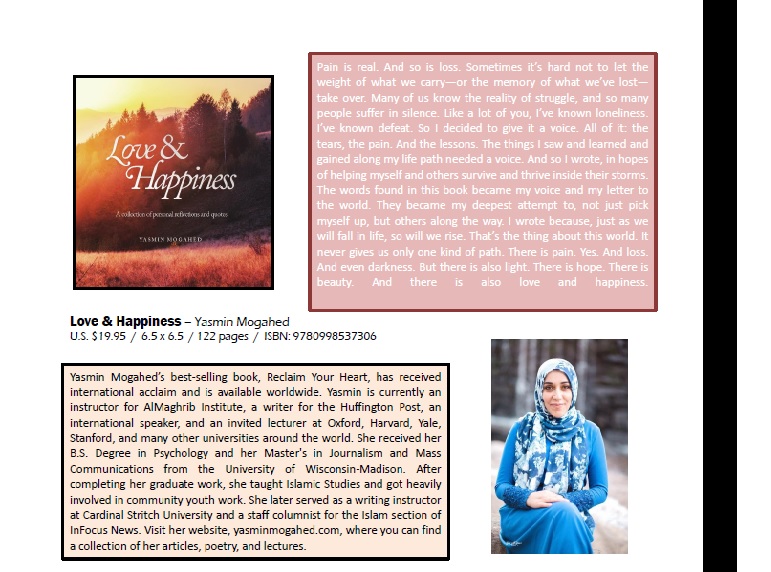
Book Review- Love & Happiness by Yasmin Mogahed


It always amazes me that so much meaning can be conveyed in the fewest of words. Sometimes we don’t need pages of words, because the right words can be so powerful. This was highlighted for me when I read Yasmin Mogahed’s latest book “Love & Happiness”.

In this book she shares some of her reflections about love, pain, loss and connection. The words are short and to the point, but laden with meaning to the extent that it left me in tears. It is said that books “speak to you” and this one has done just that. The words resonated with me and struck a chord.

Everyone goes through some sort of loss and difficulty in life and it’s not always easy to remain patient or to look at the bright side, but this book embraces the human emotions that people usually find so difficult to discuss. It not only embraces these emotions but celebrates it as being innately human. Thereafter it goes on to tell you that you have the ability to survive. “This too shall pass”, these words are reiterated in the book, reminding us that nothing is ever permanent and there is so much to look forward to. It encourages us to keep loving, despite the loss and it reminds us of real happiness, the type of happiness that comes with experience and maturity.

I loved everything about this book, the meaningful words, the beautiful images, the reminders and the deep self-reflection, but what I loved the most was the insistence on a sense of balance. We are reminded not to become consumed by any state we are in, whether that state is happiness or sadness. This reminder helps the reader to reflect on the true reality of this transient life and it guides towards the real happiness, the real love, the ever permanent bond between creation and our Creator. The way in which this is done is so natural and so profound. There are no judgements or harsh words, there are simply words of experience, of deep emotion, words that comfort the reader and allows us to accept our humanness.

The cover has been perfectly chosen to represent what the book is. A ray of hope, the sun shining through a forest of darkness and illuminating everything, making things clear and shedding light on the beauty that may have been forgotten or overlooked.

This book would make a great gift for anyone, but would be especially beneficial for those suffering loss or grief. I would definitely love to gift this book to a few people myself. The words are portrayed so perfectly in this book that nothing more needs to be uttered.

To read more about this book and author go here:


Monday, June 20, 2016

Book Review- "Behind Picket Fences" - by Hend Hegazi


It is said that you never know what goes on behind closed doors, and if perchance you happened to be the fly on the wall of someone’s home you would be surprised by how different your perception is to what really goes on.


This is the thought I had when reading “Behind Picket Fences” by Hend Hegazi. The narrative focuses on the lives of four families in a neighbourhood and the drama that unfolds shows that what things seem to be is not always as they are. From the psychological and emotional struggles of the beautiful young artist Summer, to the illness suffered by May, the caring mother and loving wife, to the financial difficulties affecting the marriage of Morgan and Mariam this book reminds us that life is filled with various trials. It allows us as the reader to get out of our own world for a while and to broaden our ideas of what life should really be like. We are reminded that no one is without trials. In fact even a seemingly perfect marriage like that of the characters Sidra and Farris is filled with its own trials.


This book is a lovely portrayal of the trials and tribulations of life, the way in which people understand and depict love and the things they would do to achieve happiness. It sheds light on the fact that human beings are complex creatures and our motives and actions may not make sense to each other, but often come from genuine feelings. It touches on the idea of tolerance and reminds us that if we do not empathize with and tolerate one another then we will miss out on having meaningful relationships with others.


The book also allows us to focus on the fact that although we are all very different, in essence we are actually more similar than we think.


I enjoyed how the characters came together to support one another even though they may not have understood each other’s lives or situations. The neighbourly spirit was brought to the fore as characters put their own issues aside to help out and see to the needs of their neighbours. It was refreshing to see people depicted as supportive instead of hostile towards one another.


One thing that bothered me while reading though was that I had to wait a few chapters to find out what happened to the character as the book was divided into 4 stories and each chapter focused on a different story. At times I found myself filled with suspense, wanting to skip chapters just to find out what was going to happen to the characters I was reading about.


All in all I enjoyed reading this book. It tugged at the emotional heartstrings and presented relatable stories. The characters and their struggles are identifiable to people across cultures and religions. What the book focuses on is the human experience and the essence of life. It reminds us not to judge anyone because indeed, we never know what goes on behind closed doors, or in this case, behind picket fences.


To read more about this author:


Image from here

Tuesday, December 1, 2015

Book Review- ‘Travels in a Veil’, by April Fonti


‘Travels in a Veil’, could perhaps be described as a social anthropological study, although it does not intend to be this exactly. April Fonti writes about her travel experiences in Pakistan, Sweden and Iran. Her encounters with Muslims are described and more specifically the book centres on her experiences and observations of Muslim women and the issues faced by them. But I found that this book was not only a journey of discovery of Muslim women, but also a journey of discovery of herself and her own views regarding Muslims in general and women in specific.


Now, we all know that issues regarding Muslim women have become a very controversial and much debated discussion, and it is for this reason that I find books like these to be extremely important to read. As a Muslim woman myself I obviously have a vested interest in this topic and a need to know what is being discussed. This book has reminded me of something crucial and that is, that it is extremely dangerous to make generalizations about Muslim women. I have to admit that some of the things that April describes in her book are alien to me, which further emphasises the need for understanding, even amongst Muslims from different countries and regions. I like that April makes mention of the fact that generalizations cannot be made, and she backs up her own experiences with other studies and expert opinions, which I felt grounded the book within a broader context.  


The book is divided into 3 parts, and the chapters are named after women that April met in her travels, thus each chapter focuses on the experiences of those women.

The first part discusses April’s travels as a single woman travelling through conservative Pakistan. Here she experiences intense seclusion of Muslim women in a way that seems to really disturb her. She also experiences what it is like to transgress the social and cultural laws. Of significance is that this is the place where she meets Shaheen, an Iranian man who is someone who she initially admires for his liberal views. Shaheen is an important person in this book, not because of the relationship that develops between April and him, but because of how he allows April to come to certain conclusions about Muslims and gender issues.

The second part of the book focuses on April’s time spent living in Sweden with Shaheen, and mixing mainly with his Iranian friends. She becomes a sort of participant observer in Sweden, because as much as she is part of the Iranian Muslim community there, she still largely ends up feeling like she doesn’t exactly fit in.

The third and final part of the book I regard as a sort of re-discovery period. Here April travels alone to Iran and through Pakistan and India again, and she sees things through the eyes of someone who is older and much more experienced.


I have to admit that I liked reading the book, it was sort of like reading someone’s travel diary and it had a personal touch to it. I also like that the complexities involved in the discussion of Muslim women and liberation, freedom, seclusion and so on, was highlighted through experiences. Nonetheless, I still have some issues with this book.


My biggest issue with this book is that at times I find that April tends to judge women a bit too harshly. As much as she attempts to be open-minded and ready to empathize with the experiences of Muslim women, she still tends to view them from a Western ideological perspective. Her own ideas of empowerment and liberation still seem to take the foreground even when she makes mention of the fact that perhaps Western liberation is not such an easy answer.


I would have liked it more if she had met and observed these women without prior ideas of what it means to be a liberated and independent woman, but of course, I understand that this is not easily achievable. The reason that this is one of my biggest issues though, is that it is generally expected that everyone’s ideas of liberation and empowerment should be similar. However, studies have proved that people from different cultures have different understandings of what empowerment means. In my own Masters study conducted on the empowerment of Muslim women, I found that the Muslim women I studied generally would not be regarded as empowered in accordance with dominant empowerment theory, and the reason for this is because they see empowerment in very different terms. For instance, for the women in my study empowerment was not about individual independence but about being part of a group and giving back to the community through this group interaction.

I understand fully that April’s travels took her to particular parts of the Muslim world and she thus came to view Muslim women in a certain way. Perhaps if she had traveled to other parts and met different Muslim women then her ideas would have differed vastly. But, be that as it may, her encounters have left her with the belief that a reinterpretation of Islam is necessary in modern times. This again is a topic which has become debatable, I personally am of the opinion that Islam needs to be understood for what it really is, instead of observing Muslim practices (which most of the time are so closely linked to cultural practices that it’s hard to tell the difference between what is religious and what is cultural). I think that a true and unbiased understanding of Islam in its entirety and not the way Islam is being practiced by certain people is essential before making claims of the need to reinterpret, but this is just my opinion.

I admire April because unlike many other people, she has decided to write based on experience, but as a Muslim woman, I do not believe that the actions or reactions of the people that she encountered is representative of the real teachings of Islam. Islam emphasizes respect for women, it insists on no compulsion in religion, its rules and punishments are the same for both men and women (despite what many people practice and believe). In Islam it is not acceptable for a man to take advantage of any woman, it is not even permissible for him to touch an unrelated woman. Men are also not supposed to be mixing with women on an intimate level, and men also have a dress code. There are so many other things I can mention here, but I think it diverts from what is relevant to this book.


I will end by saying that there were certain parts of this book that left me feeling uneasy, and I couldn’t understand why it did, because after all, this is a book about someone’s experiences and it shouldn’t have to match my understanding of things, in fact, I wouldn’t learn from it if it did match my understanding. I took some time out to try and make sense of why I felt this way and I realized that it’s because for me and the women I know, Islam is about our personal religious beliefs, rather than only being a social, cultural or political system. So you will find me wearing the black abaya and not finding it stifling at all (yes even in the midst of summer), and you will find me content when I am wearing my headscarf, and you will find my friends happy to cover their faces, and many of us have made the choice to be stay at home mothers and wives without regarding ourselves as dependent, but the difference here is that we have made the choice ourselves.  I think that these choices we have made is the defining thing, perhaps if we had not made the choice ourselves then we wouldn’t be regarding these things as liberating while other Muslim women regard it as stifling or oppressive.


So again, one of the biggest things that this book has reminded me is that generalizations are extremely dangerous; just like generalizations of Muslim women are dangerous, so are generalizations of things like empowerment, liberation and independence. I’ve written this before on my blog and I will mention it now, I do not feel the need for any particular ideology to be “The Standard” by which everyone in the world lives their lives. I think that people should be allowed to make their own choices of what makes them happy, and I think that people should be allowed to define their own “Standard”.


All in all, I would recommend that you get this book and read it, look how much discussion it has generated in just one review. If anything, it is a book that brings about discussion, a book that has an intention of asking the difficult questions and a book that focuses on experiences instead of simply accepting hearsay, and for these reasons I recommend you to read it.


Read more about April and her travels here and here

Images from here  


Friday, October 2, 2015

Book Review- Without Shame- By Katherine Russell

My first opinion of this book was that it was going to focus on the typical discussions of women and shame. Set in a predominantly Muslim society, I expected something much more stereotypical and clichéd. So I was quite pleasantly surprised when the book turned out to be very different from my expectations.


Let me say at the outset that many of the cultural aspects in the book seemed foreign to me, despite me sharing the same religion as the characters. There were certain beliefs and practices in the book that would not be regarded as part of Islam for many Muslims. To give one example, the rules of Islam forbid a man to be married to two sisters at the same time. Similarly, some of the practices described with regards to illness and magic would also be frowned upon by many Muslims. Nevertheless, at the same time I do understand that this is simply just a portrayal of Islam, as observed by an individual and perhaps as it has been practised by a particular group of people. I have to at least commend the author for making an attempt to portray different angles and viewpoints. Having said that, I will now focus on what I liked about the book.


The book is set at a time in history when Bangladesh was still known as East Pakistan and when that country still didn’t gain independence, towards the late 1960s, early 1970s. The historic and political discussion which underpins the story in this book thus makes for interesting reading. I personally did not know much about the history of Bangladesh and reading this book encouraged me to research more into this. In this regard I think the author has managed to start a discussion on very crucial topics, topics that are still, if not more, relevant in today’s times.


For instance, she brings up pertinent issues of culture and language and how Colonialism affected people’s lives on these different levels. Moreover, she begs the question as to whether foreign education in developing countries actually works for the people or against them. I particularly enjoyed the intellectual debates between characters in the novel. One of the main characters Sajib, for instance puts forth the question as to whether English really is the language of progression and whether American education in East Pakistan was valuable or if it served to further strip the people from their culture. Interestingly I could relate to these discussions so easily as we are still having the same debates and discussions today, this is relevant to me as a South African as well and we often find ourselves having to grapple with issues of cultural identity in the global world.


The political angle of the book did not overshadow the narrative and because it was so naturally written as part of the main story, it was not boring at all, instead it proved to be insightful.


The most important focus of this book though was on female liberation and independence. The protagonist is a young woman named Sariyah. Sariyah has always been different to the women around her. She is a woman of spirit an adventure, always interested in pushing boundaries and obviously this doesn’t sit very well with the people in her small rural village, especially her immediate family members. Sariya is destined to meet Rodney, an American volunteer who comes to teach in her village. The relationship that develops between these two characters brings out some of the most pertinent issues in the book. This is where Russell focuses personal issues of female freedom and what liberation means to different people and I think the friendship between these two characters also gives us insight into the need to develop an understanding of other people as opposed to simply making assumptions.


All in all I found this book to be a worthwhile read. Not only was it an educational experience but the story was intriguing as well.


Image 1 from here 
Image 2 from here 

The book comes out soon, to find out more see the publishers website: http://fbpublishinghouse.com/

Read more of the authors work here: http://www.katherinekeepswriting.com/


Friday, September 18, 2015

Book Review- Best of Creation by Abu Muawiyah Ismail Kamdar

To be honest I have generally come to regard self-help books with some pessimism, mainly because a common trend is the focus on unlimited power of the individual. Frankly, some of these books put forth assertions that are just way off the mark, and people may easily find themselves in deeper despondency in their attempt to follow what these books put forth. Also, my work as a counsellor has shown me that many popular trends are attempted by people, but there is no sustainability and people often find themselves back where they began, thereby rendering self-help books to be not very helpful at all.


This is why “Best of Creation” by Abu Muawiyah Ismail Kamdar is such a refreshing read. It goes to the core of things by firstly establishing the importance of realising our reason for existence. Once this is discussed, the book moves on to focus on how we can become confident individuals and what is stopping us from reaching our potential. The entire book works within the framework of our lives as the Creation of Almighty Allah, and it is within this context that we are encouraged to find our potential and become self-confident and productive individuals. I think this understanding is crucial for us to find the balance between self-confidence and arrogance, and this is a point that is brilliantly covered within the book. In fact, the author takes the time to explain the difference between self-confidence and arrogance so that people are able to embrace confidence as an essential part of living a meaningful life.


At the same time though, the individual is not ignored. On the contrary, individual differences are embraced and encouraged and the author makes it a point to show exactly how we limit ourselves when we decide to blindly follow the society in which we live. He reminds us that we all have different capabilities, interests and potential, but it is through these various differences that we can have a society that thrives.


The book is practical and puts forth easy to implement skills. Most of the chapters end with “Action Points”, which are practical suggestions for working on the issues discussed in the chapter. This is a very helpful addition as it provides the direction in which to go, it also forces people to take action and in this way it becomes easier to remember and act upon what was discussed in the book.


I found myself needing to highlight some of the sentences as it just resonated with me. Here are some of my favourite quotes from the book:

“True Self- Confidence comes from understanding the purpose of our lives and our relationship with Allah.”  

“We must also understand that we are Allah’s creation and we are not allowed to mistreat the Creation of Allah, and that includes our own selves.”

“One of the ways that parents ruin their children’s confidence is by expecting perfection from them.”

“It is our duty as believers to never stop learning, growing and becoming better Muslims.”  

“The Self-Confidence of a believer is also free from arrogance. It is a humble acceptance that as a servant of Allah, we have great gifts that need to be used for a greater purpose. With this in mind, we develop our gifts and use them productively.”  


There are many other quotes that stood out for me, but it needs to be read within the larger context of the book in order for it to be effective. The thing I liked the most about this book is that it emphasizes that Self-Confidence is not only for some people, but everyone should be confident, because after all, we all have the responsibility to live up to the title of “The Best of Creation.”


I would recommend this book as a must-read for everyone, anyone who reads this is certain to gain some sort of benefit from it. 

Image from here 

To find out more about  the author, this book, and to purcahse it, here are some links below:


HERE IS THE AUTHOR'S WEBSITE, WHICH INCLUDES SOME VERY VALUABLE INFORMATION:


LOOKING FORWARD TO HEARING YOUR COMMENTS ABOUT THE BOOK SOON, INSHA ALLAH! 


Monday, July 6, 2015

Book Review- Brick Walls


I began reading this book with the intention of reading it casually over some time, but this was not to be. I was immediately hooked at the first story already, and subsequent stories easily managed to maintain my interest, keeping me intrigued and unable to wait to read more.


The book is a collection of short fictional stories set in Pakistan. Each story documents a different sort of struggle, but with the struggle comes perseverance, endurance and eventual triumph. I have always had a strong belief that important social and political issues can be conveyed effectively through literature, and Saadia Faruqi proves this belief to be right in ‘Brick Walls’. Through the stories in this book, the social, political and economic climate of Pakistan is vividly portrayed giving the reader a much deeper understanding and awareness of the dynamics that are present in a country like Pakistan.


The main characters in each story are multi-dimensional and I enjoyed how their emotions and conflicts were explored. It reminded me of the intensity that is the human experience.

Coming from a developing country myself, I could identify with the central themes of poverty and inequality, crime and corruption and abuse of power. The thing that stood out for me though, was that social, economic and even political barriers cannot hold back the human spirit.  Faruqi managed to show that things like morality, kindness, selflessness, ambition and perseverance are not restricted to those who are in power, and thus although the world is rife with inequalities, the odds can be beaten and overcome. I particularly like how she portrayed this in a story entitled ‘Making the Team’ about a little girl who desperately wants to play cricket with the boys in her community. This story was one of my favourites because it manages to successfully focus on power roles and bias in a non-conventional manner.

What was evident throughout the book were the themes of love and hope. The author seems to have a deep love and identification to Pakistan and the hope that she has for the people of this country is clear. Hope prevails in each story, and the potential for change and growth is a constant reminder. After reading this book, I have being made to understand Pakistan and the people of Pakistan in a different manner. There may be many issues to deal with in this country (as is the case in all countries), but as long as there are people who are willing to make a difference, no matter how small, the hope for a better future will continue to prevail.

In the end I am left with the distinct feeling that it is those people who work silently in the shadows to give of themselves, their wealth and their time to bring about positive change, who are the real heroes and role models of the world. Saadia Faruqi has illustrated this beautifully in this gripping collection of short stories.

Image from here 

Read more about the author and her work here  -http://www.saadiafaruqi.com/

Get a sneak peek of the book here


Friday, June 12, 2015

Book Review- “How to be a Happy Muslim- Insha’Allah”


When reading this book I couldn’t help but approach it from two different perspectives. Firstly, as a counsellor myself I automatically tended to read the book from the perspective of a counsellor. From this viewpoint I can sum this book up as an extremely valuable resource. It is definitely a book that I wouldn’t hesitate to recommend to all my clients. Throughout the book I felt almost as if the author was echoing my own thoughts and speaking my own mind.


What I found the most useful was that the book was written in such a simple and practical manner, there is no room for confusion or misunderstanding. The advice's are so clear and to the point that anyone can read it and implement the skills and lessons brought about, and further useful links to websites, videos and other resources are provided so that the experience of implementing change doesn't have to end with this book. Which brings me to the thing I loved the most about this book. The author takes an active stance instead of a passive/victim one and she encourages everyone to take control of their own lives and their own feelings. Instead of waiting for someone else to do something, she shows people how they need to do something themselves to become happy and she gives them the basic tools with which to do this. If anything, the thing that should be taken away from this book is that happiness (in terms of contentment and inner peace) is not something which only a few people can achieve, it is something attainable for everyone, but it involves some sort of action to be taken in order to maintain it.

In addition, the approach the book takes is holistic and it focuses on all aspects of human functioning and combines the different levels of functioning to show that happiness is a holistic thing in itself. In doing this, it highlights the need for us to view our lives holistically and from there to make the necessary changes on a more meaningful level.

My second approach to reading this book was from a personal level, with the constant awareness that this book applies to me as much as it does to any other person. On this level too, I was not disappointed. With every topic I found myself easily able to apply this to my own life. The thing that stood out for me personally was the discussion on gratitude and focusing on the positive in our lives over the negative. I can vouch that becoming more grateful leads to feelings of contentment and peace and the tools provided in the book to become more grateful and positive was very helpful in emphasizing this. I also found the Happiness Reflections and Happiness Hints to be very beneficial in bringing the topics back to my own life, thereby making the reading of this book a personal experience of reflection and self-understanding.


People often ask me the question, “but how can I become happy?” While reading this book I felt like I was getting a very in-depth answer to that question and I think that the next time I get asked this question, my answer should simply be to recommend them to read How to be a Happy Muslim-Insha’Allah. It is indeed a book which provides solutions to issues that many people are attempting to deal with and I am certain that many others will find it as helpful as I have, Insha’Allah. 

Image from here

You can read more on the author's website here 

Friday, January 24, 2014

Book Review- ‘Reclaim your heart’, by Yasmin Mogahed


It is said that you should never judge a book by its cover, but I have found a book which is as beautiful on the outside as it is on the inside. The yellow autumn leaves and the sun shining through reminding us that through the changes of life, through happiness, grief, loss and even in death, there is hope shining through, that hope is the connection to the One Creator, that hope is undeniable and for me this book echoes this above anything else.


What was deceiving however, was the fact that it looks like a book that you can read very quickly. A thin book of 168 pages shouldn’t take that long to read, this was my initial thoughts. Yet I was wrong in this regard, because the topics of discussion and the way in which it is discussed is so intense that it requires reflection and contemplation, thus taking me much longer to finish the book.


The book in a way promises the reader a journey of enlightenment, where the heart will be set free from the shackles of life, and it has indeed kept its promise. The only thing left to do is to implement the wonderful principles mentioned here in.

I particularly enjoyed the style of writing. It’s the type of writing that does not confuse the reader, nor do the words get lost. Instead, it’s written in a straightforward and conversational manner, easy for anyone to grasp. It begins with discussing the attachments or rather false attachments that we so easily form and it tells you how to go about forming a real and everlasting attachment with Allah (exalted is He). Similarly, the reality of issues such as Love or Hardships or even our relationship with the Creator is discussed in a manner which allows the reader to reflect on what the reality is, as opposed to all the false illusion in our lives. The book ends off beautifully with poetry, but it is not just any poetry, it is poetry which speaks of true connection to the Lord, connection as a spiritual being, and this in itself is extremely moving.

The words in this book are not meagre words, they are words that have the ability to elicit tears, tears which come from knowing and recognizing the truth and then attempting to find this truth within yourself. Each time I picked up this book to read, I looked forward to crying as much as I did to reading, because the words, coupled with tears led to some sort of real understanding of my true purpose as a human being in this temporary world.

As humans we have many questions, and I believe that this book provides the answers to most of those questions. If you are not willing to face the truth though, and if you are reluctant to introspect and work through the illusion in your own life, then this book will not be of benefit to you.


I commend Yasmin Mogahed for writing a book which is a real treasure. In the book she urges people to ‘Reclaim their hearts’, to move it away from everything that is false and direct it towards that which is real. This book is an eye opener and a reminder at the same time, and it speaks more to the heart than anything else. It’s taken me a while to read, but I hope that this means I have been able to implement these lessons in my life, and moreover, I hope that I can continue to work on reclaiming my heart, because one day I will have to return ‘home’ to a place better than this earth as Sister Yasmin reminds us, and I truly wish that my return home will be a joyous one, In sha Allah! 

IMAGE FROM HERE 

To read more from Yasmin Mogahed's check out her website:

http://www.yasminmogahed.com/