Tuesday, December 30, 2014

“Diary of a Guji Girl” and What I think we should be discussing

Like many people I have been an avid reader of the blog ‘Diary of a Guji Girl’. Initially I was interested in reading the blog because of the huge hype that surrounded it, eventually though I found this to be an educational experience for me in many ways. So a few weeks ago I was delighted to have finally received my copy of the book based on the blog, and I set aside an evening just for reading this.( I must say as a side note that holding the book in my hands was so much better than reading the blog). Nonetheless, the book has marked the end of this story and like all stories I find myself at odds, there is closure, which is always a good thing, but for me the lessons derived from this story is far more important and it surpasses all the hype, the popularity and everything else that has come with this.


I admire the author Qaanitah Hunter for boldly discussing issues that no one else dare speak about, and I love that she has made such good use of satire and humour, there’s this nagging part of me though, a part that tells me that perhaps people didn’t take the messages from the book exactly in the way it was intended, that the characters were “glorified” by readers in ways that should not have happened and that the reflection of our society as portrayed in the story has not been concerning enough for people. Perhaps it’s just me over analysing things again, I don’t know, but in any case, I decided to mention the lessons that I have learnt and what I think we should be discussing after reading this story.

For those of you who aren’t familiar with the story, the very basic summary is that this is a story of a first year university student, Amina, who leaves her home in the small town of Newcastle to come to the big and sometimes very unfriendly city of Johannesburg. On the way she meets new people, has different experiences, but it is mainly Amina’s obsessive quest for marriage that forms the basis of this story, and it is her “relationship” with the typical messed up, unstable, but very good looking, rich and popular guy that forms the central focus.

The biggest lesson that I derived from this blog/book is also the scariest one so I’ll begin with that. While reading this it dawned on me that the biggest threat to the religion of Islam in South Africa is cultural heritage. Now, before people jump down my throat, please allow me to explain. Diary of a Guji Girl has very perfectly depicted how Muslims in South African Indian society hold on strongly to their cultural heritage. This in its own is not an issue, but it becomes an issue when it is at the expense of the way in which Islam is practised. The problem of cultural heritage surpassing Islamic teachings is so evident in the story, for instance when Amina judges her Cousin Ayesha’s future husband because he is not from the same cultural background. Besides this very overt depiction of what I am talking about, the characters in the story all tend to hold on to cultural practices like it’s the law. There is no questioning the relevance of these practices and very often cultural practices surpass religious ones and people are judged when they decide to choose religious practices over cultural ones.
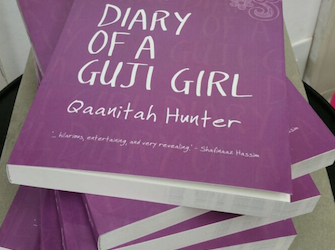

The reason for this being scary or worrying is that when people place more importance on their cultural heritage than anything else, this can cause division, racism and prejudice and it can be a huge hindrance to Islamic unity. I see this too often in the society in which we live, and coming from a mixed cultural background, I myself have been a recipient of the prejudice I allude to, and so reading about it in Diary of a Guji Girl just brought home this issue so aptly. But the scariest part of it all is that people don’t stop to think about the negative impact this may have and instead remain insistent that their particular culture is “the way things should be”. I personally think that Diary of a Guji Girl was an attempt to change this type of thinking, showing in a very satirical manner that maybe the way we have been thinking all the years is not always the right way. Whether readers actually took this message seriously however is another story.

The other issue that stood out for me was the overly obsessive pursuance of marriage. Now, I am not at all disputing the importance of marriage. Islam definitely does place emphasis on marriage and even regards it as “half of faith”. However, in this overly obsessive quest for marriage, we seem to have forgotten the true purpose of marriage in itself. Marriage is supposed to be a means to the end, not an end in itself. This Hollywood style search for happily ever after, (or in this case, the happily ever after in the smart Houghton house with the good looking, rich and popular man) can only lead to trouble. As Muslims the only happily ever after that we are supposed to be pursuing is the one we are promised in the Hereafter. If marriage is not going to make us better Muslims who are constantly trying to improve ourselves in our striving to reach closeness to Allah Almighty, then this means is not a very positive means to the ultimate end, now is it? With this crazy obsessive search for the perfect man and seemingly perfect life, it’s no wonder people get divorced so easily these days. May Allah guide and protect us all!

The last issue that I’ll mention here is the materialistic nature of people. As the protagonist in the story, Amina’s materialistic nature actually becomes so annoying that at some points you want to smack some sense into her. This is more evident in the blog posts than it is in the book, but nonetheless, it highlights the fact that many of us have lost the plot and we have become selfish and self-absorbed. I don’t know how other people feel, but for me spending R2000 rand on one shopping trip on nothing other than clothes is absurd. I love that the author made an attempt to bring Amina back to reality and make her realise that life is about responsibility and not being wasteful, and of course about sharing with others as well if you can afford to do so.

There is so much more that I can say about this story, so much more details to discuss about the issues brought about in it, that’s why I was disappointed when all people could focus on was the “love story”. Naturally this brought up a whole lot of other questions for me. Why do people love Moe and Amina together? What is it about the attraction of ‘good girls’ to the ‘bad boy’? Is life really all about finding love? What are our ideas of love even based on? Should young women really be putting themselves out there and doing whatever they can to secure a good marriage prospect? How much will parents overlook and give in so that their daughters end up marrying a good man? Is society’s viewpoint really that important? Has money and status really become so important to us that we are willing to compromise on our Islamic values? …


Yes, it is evident that there is much more that I can discuss about this story, but the story has ended so perhaps I should end my thoughts here as well. I would love to hear other thoughts on this though, perhaps someone else has good answers to all my many questions.

Image 1 from here 
Image 2 from here  
Image 3 from here


Thursday, November 20, 2014

Stupid old stereotypes and inspiring Muslim women


I’ve long since given up the need to refute common stereotypes about Muslim women. Of course I’ve always known that these stereotypes were nothing short of ridiculous. I’ve said this numerous times, and will say it again, Muslim women can never be stereotyped and categorized into one general whole. Nonetheless, I’ve recently come into contact with Muslim women involved in so many different projects that it reminded me that stereotypes are undoubtedly a sign of stupid thinking. So I thought I’d just share with you some of the projects that Muslim women in my community have recently begun.


My favourite project is the recent development of a Book club, cleverly named “Book Bytes”, this book club ensures that Muslim women (and women from other faiths who would like to join) come together and discuss their favourite reads and encourage each other to read new and different books. I have not previously been exposed to so many women who love reading to the extent that I do and I must say that I am impressed. This proved to me that intellectual thought and intelligence is vivid and thriving amongst Muslim women and contrary to a common stereotype, there are women out there who would prefer to buy books over shoes any day!


Last month some time I was invited to speak at a support group. This group called, H4U (Here for You) has been established by two very ambitious, bold and outgoing Muslim women who have the intention of improving the community in which they live. I left that meeting feeling so impressed and inspired by all that I had heard. It’s always a beautiful thing to witness or hear about the growth in someone else. It reminds me of the vast human potential that we have and how anyone is able to accomplish whatever they want to.


As part of this support group these women are involved in a variety of projects, including drug 
counselling and support, and counselling and assistance for many other issues. They’ve also set out to do youth upliftment and a kiddie’s recreational programme. Honestly I know how much time and effort it takes to arrange all these activities and projects and I really admire these women for their selflessness.


Then, just recently I was put in touch with a dynamic group of Muslim sisters, most of whom had converted to Islam fairly recently. I can’t tell you how impressive these women are. Masha Allah! The genuine love and care that they have for one another and the support that they constantly offer each other has left me in awe. I pray that their bonds are strengthened.


These are just a few of my most recent encounters with amazing Muslim women. I have had many others, and I am certain that there will be many more. For this reason, I now have resorted to smiling silently or simply dismissing the relentless stereotypes of Muslim women. If anyone is stupid enough to believe and follow these stereotypes, then all I can say is that there’s a major problem with them and there’s not much else I can do about that.


INVITATION for "YOU ARE BEAUTIFUL" Book PRE-ORDER SALE!!


INVITATION for "YOU ARE BEAUTIFUL" Book PRE-ORDER SALE!!
 
Full Image

BE AHEAD OF THE CROWD

The release date for "You Are Beautiful" (Mindworks Publishing) is November 28, 2014. However, you can be ahead of the crowd by pre-ordering your copy of the book now.  When you pre-order your book, you will receive an autographed copy from the author.

This book will make a wonderful gift for loved ones with children or your local school library. The ideal age for this children's book is 9 - 12 (grades 3 - 6).  Click the link below to pre-order "You Are Beautiful"  
TODAY!

http://www.mindworksbooks.com/#!coming-soon/ccbn

​Thank you in advance for your support.
yd2yd2

Wahid and His Special Friend

Motivated by a driving need of diversity in many of the genres of books, particularly for children, as well as her love for writing, Abdusamad’s first book, “Wahid and His Special Friend” (Authorhouse Publishing), is a cute rhyming book that is a quick read for children ages 0 – 7.

Click on the link below to purchase your copy.


​http://bookstore.authorhouse.com/Products/SKU-000679403/Wahid-and-His-Special-Friend.aspx

yd2

About the Author

Robyn Z. Abdusamad was raised in Chocowininty, North Carolina.  While in college, her love for writing would lead her to work as copy editor for the university’s year book, publish articles in the NC A&T Registar and the Greensboro News & Record.  She graduated from NC A&T with a Bachelors of Arts degree in Communication and Public Relations and accepted a job offer in Atlanta, GA as a Marketing Coordinator for CIGNA Healthcare.  After several years in GA, the company downsized forcing Robyn to return home to NC where she found a job working for National Multiple Sclerosis Society as a Community Events Manager and Editor. She later returned to her alma mater as an Assistant Director of Annual Giving and further developed her public relations and fund raising skills. She also found herself working in the Greensboro Public school system as a Site Director for their after-school program. That experience coupled with raising young children is what first peaked her interest in writing children’s books.

While enjoying her career she continued to write and eventually returned to school and completed her Master’s degree in Public Administration from National University.  Once she became a wife and a mother she became serious about writing children’s books—ultimately writing five books (two of which are published). Currently Robyn and her family reside in Texas-Dallas Fort Worth area. In addition to her freelance writing, she also works as a public relations consultant.  Her hobbies include spending quality time with her husband and their three children, traveling, reading, writing and volunteering in the community.
yd2

yd2

Imagine. Create. Dream. BECOME!
Facebook Twitter
www.omeraproductions.com
Email: omera.productions@gmail.com
 

Thursday, October 30, 2014

Interview with an author

Masha Allah, there are so many amazing women out there who are using their talents in a positive and productive way. I have had the privilege of coming across one such woman, sister Robyn Abdusamad, who is an author of children's books with a difference. Here's my interview with her, I hope that you find it as inspiring and interesting as I have. 

************************************************************************

  
1.    Tell us a little bit about yourself and your background?


     I am from North Carolina but my family recently relocated to Texas, the Dallas-Fort Worth area.  I am a graduate of North Carolina A&T State University with a Bachelor in Communications/ Public Relations and a Masters in Public Administration from National University.  I have over 10 years of experience in the nonprofit sector. I’ve also worked in the secondary school system in North Carolina. Right now, I am a stay at home mom.   In my spare time I enjoy volunteering in my community, traveling, shopping, and connecting with family and friends.


2.    Is this your first book? If not, what other books have you written and what were those about?

In 2013 I published my first book “Wahid and His Special Friend” (Authorhouse).  It is a cute rhyming book that is a quick read for children ages 0 – 7.  Rhyming is essential for children to comprehend and play with language.  It not only tells a great story but has great illustrations and great rhymes with a hint of mystery.  “You Are Beautiful” is my second book in my line of children books.   It is about two sisters who learn a meaningful lesson about ethnic diversity as well as the importance of compassion and unity. 

3.    What inspired you to write children’s books?

Being a mother who wanted to make sure that my children developed a love of reading introduced me to the world of children’s literature. As I began to purchase books for my kids, I noticed a lack of books that focused on the needs of Muslim children. So that void in the market is what inspired me to try my hand at children’s books.  So, with the support of family and friends, I took that leap.

4.    Your latest book, “You are Beautiful” is due for release this November, this looks like a very interesting book, please tell us a little bit about this book?

Yes. It is scheduled to be released November 28.  “You Are Beautiful” (Mindworks, 2014) is about two sisters who are saddened by a racial comment made by some of their peers.  It is a heartfelt and inspirational lesson that teaches young children how they can embrace diversity with knowledge and kindness. 

5.    What was your motivation for writing this book?

My motivation for this book stemmed from the injustices we all witness in society today. Additionally, when I worked in the school system I was able to observe, firsthand, the bias that children demonstrated toward each other. So my purpose with this book, I hope, is to give parents a way to engage their children in conversations about diversity, racism and other forms of bias.  As the late Maya Angelou once said, “When we know better, we do better.”

6.    It seems that your books are aimed at dealing with important social issues, do you see your writing as a form of social activism? Also, do you believe that writing has the ability to bring about real change?

Not all of my books have a social activist theme; however, “You Are Beautiful” could be seen as such because the storyline is about overcoming intolerance and embracing diversity.  As a writer I don’t set out to be a social commentator. But as a parent and educator, it is essential to educate our children about racism, prejudice, and respect for others.   Many parents may feel uncomfortable when discussing race with their children, but considering the racial climate of America, it is a much needed conversation. Children are keenly aware of racial background and differences in (color) and when we do not openly talk about it with our children, it becomes an issue that goes ignored for generations.  Part of having good character is to not pre-judge people.  As far as my writing bringing about real change, I think my writing coupled with the dialog that I mentioned earlier can help effect change in our communities.

7.    Who is this book aimed at? (Which age group?)

The age group is for ages 8 – 12 (grades 3 – 6). This is a children’s book so it is written for them as well as parents and teachers of any race, ethnic group, gender and religion that embraces diversity. 

8.    Where can this book be purchased?

This book can be purchased at Amazon.com in paperback and kindle format.  Pre-orders are being taken now through my publisher at www.mindworksbooks.com you can receive a signed copy of the book when you pre-order it.

9.    Please share with us some of the ideas you have for upcoming books?

Currently I am working on two other children’s books; I have completed the drafts for “Zaynab’s Enchanted Scarf” and “Zakiyyah’s Flower Garden”.  Once they are published, I plan to write a book about balancing marriage and relationships. 

10. I’ll leave the final question open, please share some words of wisdom with us, anything you’d like to share.

Well, the one thing that comes to mind is the importance of surrounding yourself with people who are positive and uplifting.  Also, be supportive of those who are doing good things in our communities and treat others the way you would want to be treated.  Get to know people outside of your comfort zone despite the color of their skin because that could be the one person who enhances your life.  Keep peace in your life and know that Allah (swt) is always watching.


Jazak Allah Khayr to sister Robyn for this interview. I would recommend that you get a copy of Robyn's latest book as well as her previous one. This seems like a Must-have for every children's library. 

To Sister Robyn, I wish you all the best for the future, May Allah keep you in peace always!

Monday, October 27, 2014

The meaning of True Sisterhood

On Saturday I had an amazing day, Alhamdulilllah (All Praise is for Allah). We hosted a ladies workshop. Through the mercy of Allah, I learnt far more than I could ever teach and the experience left me feeling humbled and in awe of the perfect system of Allah and the beauty of Islam.


The group of ladies that attended was diverse and multi-cultural and naturally this meant that we got to hear a variety of experiences. I can’t tell you how beautiful it was to hear sisters talk about Muslim sisterhood and how they feel they belong. The cherry on the top for me was when a sister who reverted two years ago said that she loves us all for the pleasure of Allah and she spoke about how Islam has changed her life and how amazing it is for her to be part of the Muslim sisterhood.


Now let’s not paint a perfect picture here, because there is no such thing as the perfect picture, flaws are always inevitable and mistakes are going to be made without a doubt. It was saddening to hear some sisters speak about their negative experiences when greeting other Muslim sisters with the greeting of peace, As-salaamu alaykum, these experiences including being ignored and snubbed.


The negativities will exist of course, people are human and we are thus prone to weakness, but we need to have reminders such as these, reminders of how Allah Almighty actually intended it to be, because this will clarify our understanding when things are flawed or imperfect, it is our human error and weakness and by no means is it a reflection of Islam or how Allah intended things to be. If we understand our wrongs then only can we change it.


This all got me thinking about the true meaning of sisterhood in Islam. You see although I am a born Muslim, I wasn’t always a part of this Muslim sisterhood that I speak of. There was a time when I felt very far removed from Muslim sisters. Coming from a different cultural background from majority of the people I grew up with and went to school with naturally made me somewhat of an outsider. We shared the same religion, but unfortunately many people tend to mix culture up with religion and when I was growing up people tended to connect more on the basis of culture than religion. So since I couldn’t identify with girls on a cultural basis, this obviously made me averse to the Muslim girls around me, feeling that I was and never would be the same as them.


I recall when I began wearing hijab, one of my biggest issues was that I didn’t want to be the same as all the other Muslim women. My reasoning was that I had never fitted in with them and I disagreed with their way of seeing things in so many ways, so I didn’t want to be seen by others as the same as them. I laugh now at how I made an attempt to wear my hijab differently to how everyone else was wearing it, just so that I didn’t seem the same.


Allah had a different plan for me though, of course a better plan. Somehow through my field of work I was pushed in to working with Muslim women, and finally Allah allowed me to meet amazing sisters who valued themselves based on the religion of Islam and not on the culture they came from. Whereas before I always felt unable to connect with other women, now I began to find it easy, and this was simply only because we had common ground and a common goal and intention and that was Islam and reaching closeness to Allah Almighty.


SubhanAllah (Glory be to Allah), over the years I have been blessed to connect with many women in this way, purely for the pleasure of Allah and I have formed bonds with women in a way that I never thought was possible. I have experienced real love between sisters, not blood sisters, sisters in Faith. So this is why it moves me so much to have experiences like I did on Saturday. This is why I feel honoured to be present when a Muslim sister who has met other sisters for the first time is able to openly proclaim her love for them. I feel humbled, because Allah Almighty has allowed me to understand the true meaning of sisterhood and I know that I can connect with any sister when our vision and mission is the pleasure of Allah Almighty.


My reminder on Saturday was that Islam is not about culture, people have cultures, that’s what gives order and understanding to their everyday practices, but Islam surpasses cultural beliefs and when Muslim sisters get together, they should be able to connect with each other on a real level, heart to heart, soul to soul, all working and striving to earn Allah’s pleasure. This is sisterhood, the bonds that have been forged by none other than the Ultimate Creator. We can look beyond everything else and feel mutual love and care, we can cry with one another and laugh with one another, we can feel at home and like we belong even though we’ve only just met. We can listen to each other’s stories with patience and understanding and genuinely care for each other. This is true sisterhood and the beauty of it, the reality of it is that Allah Almighty’s pleasure is central to it. We have no need to backbite or slander each other, nor do we have the need to compete or show who is better. We understand that in the eyes of Allah we are all equal and if we truly love Allah then we will easily love each other. SubhanAllah (Glory be to Allah) over and over for allowing us to experience this true sisterhood and my prayer is that Allah allows the bonds of true sisterhood to be strengthened so that all Muslim sisters can identify with each other as one and we can stand together when we really need to do so.


May Allah Almighty guide me and forgive me and always give me the ability to see the truth wherever it exists.


Image 1 from here 

Image 2 from here